-

+86-13961903990

+86-13961903990
Industry News
 Home / News / Industry News / What Are the Fundamental Differences Between a FRAC HEAD & CASING HEAD in Well Completion?
  2026.02.09
 Industry News
Content
In the complex lifecycle of an oil and gas well, the transition from drilling to production requires specialized hardware capable of managing immense pressures and mechanical loads. Two of the most critical components found at the wellhead are the FRAC HEAD and the CASING HEAD.
While they may look similar to the untrained eye—both being robust, forged steel pressure-control devices—their roles, lifespans, and engineering specifications are fundamentally different.
To understand the differences, we must first look at where each piece of equipment sits in the operational timeline.
The CASING HEAD is the lowest part of the wellhead assembly. It is a permanent fixture installed during the drilling phase. Its primary job is to provide a base for the wellhead and to “hang” the casing strings that line the wellbore.
The FRAC HEAD (often called a “Goat Head”) is a temporary component used specifically during the hydraulic fracturing process. Once the well is stimulated and ready for production, the frac head is removed.
Because a FRAC HEAD & CASING HEAD serve different masters—one for long-term weight support and the other for short-term fluid velocity—their engineering DNA varies significantly.
| Feature | CASING HEAD | FRAC HEAD (Goat Head) |
|---|---|---|
| Operational Phase | Drilling & Production (Permanent) | Completion/Fracturing (Temporary) |
| Primary Load | Axial Tension (Weight of Casing) | High Pressure & Erosion (Fluid Flow) |
| Typical Pressure Rating | 2,000 to 10,000 PSI | 10,000 to 15,000+ PSI |
| Inlets/Outlets | Usually 2 side outlets | Multiple inlets (4, 6, or 8 “horns”) |
| Material Concern | Corrosion & Long-term Fatigue | Erosion & Impact Resistance |
| API Standard | API 6A | API 6A (specifically for Frac service) |
The visual and structural differences between a FRAC HEAD & CASING HEAD are driven by fluid dynamics.
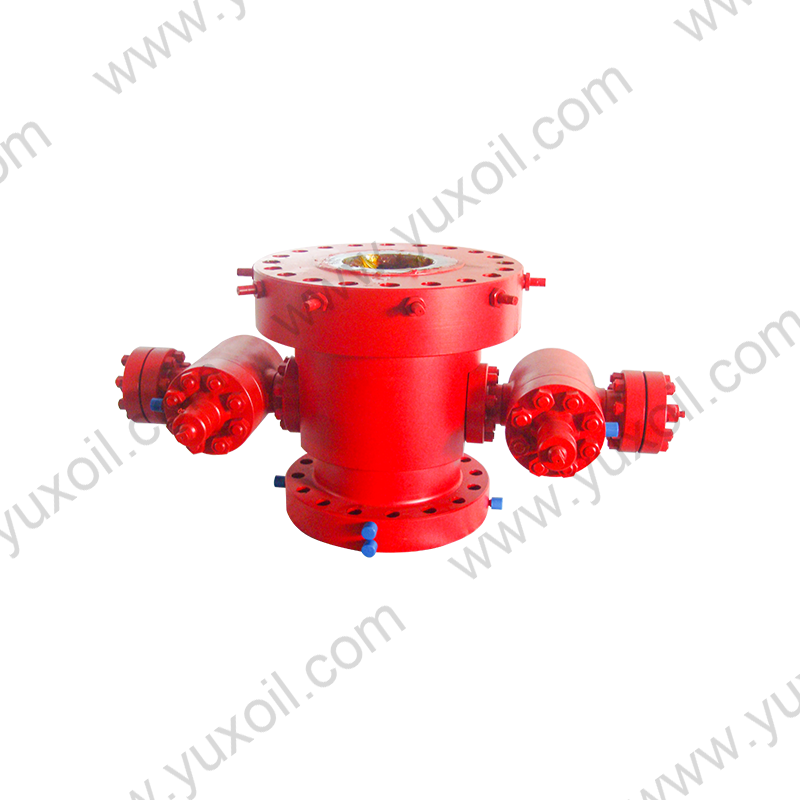
The Frac Head is characterized by its multiple angled inlets, which resemble horns. These inlets are designed to take the combined output of several high-pressure pump trucks and merge them into a single bore.
In contrast, a Casing Head is built for stability. It features a bowl-type interior designed to accept a variety of Casing Hangers. The design focuses on ensuring that the vertical load of miles of steel pipe is evenly distributed across the wellhead assembly.
In 2026, as operators push into deeper, high-pressure, high-temperature (HPHT) reservoirs, the material requirements for the FRAC HEAD & CASING HEAD have become more stringent.
Both components must adhere to API 6A standards, but the specific material class often differs:
The relationship between the FRAC HEAD & CASING HEAD is critical during the completion transition.
While the CASING HEAD is the silent, permanent guardian of the well’s structural integrity, the FRAC HEAD is the high-performance engine that enables the modern shale revolution. Understanding that the Frac Head is built for velocity and erosion resistance while the Casing Head is built for weight support and longevity, allows engineers to select the correct API specifications and pressure ratings for their specific basin.
Q1: Can I use a Casing Head as a Frac Head in a pinch?
A: Absolutely not. Casing heads are not designed with the manifold inlets necessary for frac operations, nor are they typically rated for the erosive flow of proppant. Attempting to frac through a standard casing head could lead to immediate equipment failure.
Q2: Are Frac Heads rented or purchased?
A: Due to their temporary nature and high cost, many operators rent FRAC HEADS from service companies. However, for large-scale, multi-well pad developments, purchasing a fleet of frac heads can offer better long-term ROI.
Q3: How often should a Frac Head be inspected?
A: Because of the erosive nature of frac sand, Frac Heads should undergo non-destructive testing (NDT) and wall-thickness measurements after every job to ensure that the internal flow paths have not been thinned to dangerous levels.
 No. 161, Yanhe Middle Road, Yanhe Town, Jianhu County, Yancheng City, Jiangsu Province, China
 +86-13961903990
 +86-515-86598285
 +86-515-86590688
Copyright © Jianhu Yuxiang Machinery Manufacturing Co., Ltd. All Rights Reserved.
 Login Wholesale High Pressure Wellhead/Drilling Equipment Manufacturer

 English
 русский
 Español