-

+86-13961903990

+86-13961903990
Industry News
 Home / News / Industry News / Valves for Oil and Gas Industry: API 6A Gate Valves, Plug Valves and Wellhead Equipment
  2026.10.05
 Industry News
Content
At a shale well in West Texas, a 3-inch API 6A slab gate valve failed to seal during a routine Christmas tree changeout. The crew had closed the valve, but production fluid continued to migrate through the seat. The operator lost 12 hours of pumping time and had to order a replacement valve on an emergency basis. The failure was traced not to the valve material, but to a seat and gate set that had been eroded by 40,000 ppm sand-laden produced water over just six months. A valve specified with a higher hardness trim and the right PSL level would have kept the well online.
The lesson is simple: in oil and gas surface equipment, the valve is not a commodity. It is a pressure-control component that must be selected against the actual flow, pressure, temperature, and media. The right choice depends on the API 6A pressure rating, material class, and product specification level, and on the valve design that matches the duty cycle.
API 6A is the primary specification for wellhead and Christmas tree equipment used in the oil and gas industry, including gate valves, plug valves, and the valve bodies used in casing heads and tubing heads. It defines a range of pressure ratings from 2,000 psi to 20,000 psi, along with material classes, temperature classes, and product specification levels (PSL).
For a procurement engineer, the most important point is that the API 6A nameplate is not a single number. A 5,000 psi valve can be built in different material classes. Class AA is for general service. Class EE is for sour service with high H2S. Some operators specify PSL 2 or PSL 3 for critical wells, while PSL 1 is acceptable for sweet, low-risk service. Choosing the wrong class or PSL level without checking the actual well conditions is a common cause of seal degradation and premature valve replacement.
For a deeper look at where API 6A gate valves are applied in drilling, completion, and production, see this discussion of API 6A standard gate valves in the oil and gas industry.
Many oil and gas operators also request NACE MR0175 compliance for sour service. This is an additional material and hardness requirement that prevents sulfide stress cracking. A valve that is not rated for H2S can fail catastrophically in a gas well with even trace amounts of hydrogen sulfide.
Gate valves are the workhorse of oil and gas wellhead equipment. They use a gate that moves perpendicular to the flow path. When open, the bore is fully clear, which means very little pressure drop. When closed, the gate presses against two seats to isolate pressure. Gate valves are standard on Christmas trees, casing spools, and production manifolds. There are several gate valve families under API 6A, and each one suits a different operating condition.
An expanding gate valve uses a two-piece gate that expands against the seats as it closes. The wedge action produces a mechanical seal that holds pressure even after the valve has been closed for months. This makes expanding gate valves an excellent choice for master valves on Christmas trees and other shut-off duties where leak-tight isolation is critical.
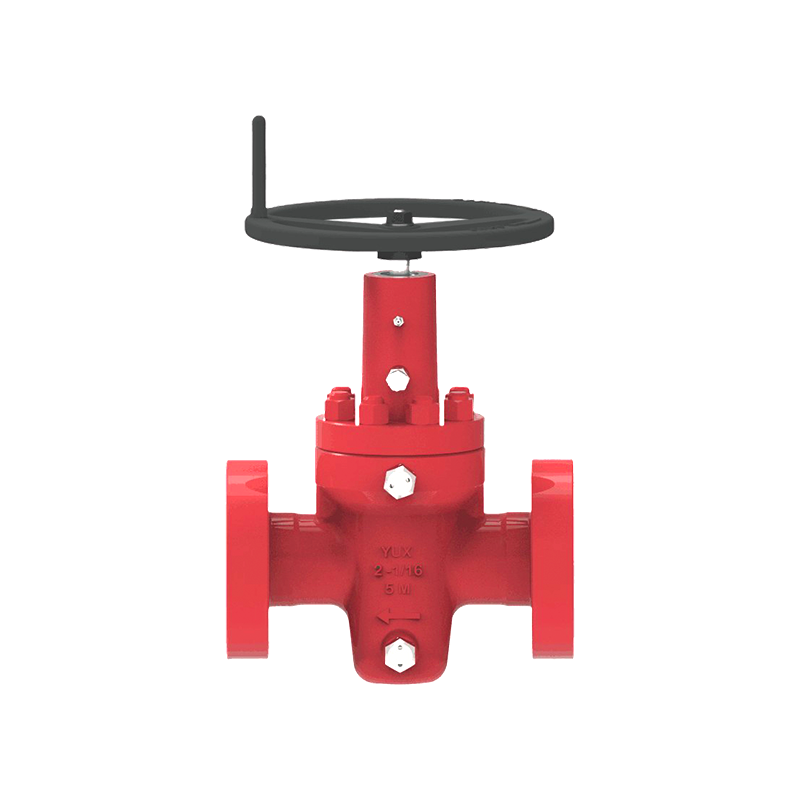 WKM Expanding Gate Valve for Wellhead Pressure ControlThis API 6A expanding gate valve is available in sizes from 2-1/16" to 7-1/16" and pressure ratings up to 5000 psi, with a wedge assembly that ensures leak-tight isolation even after long periods of closure.View Product →
YUXOIL manufactures an expanding gate valve specifically for wellhead pressure control. It is built to API 6A design and is available in the pressure classes commonly used on wellhead stacks. For applications where the valve will be closed for long periods and must not leak, the expanding gate design deserves serious consideration.
The PFF series slab gate valve uses a parallel gate that slides between two floating seats. Its construction is simple and robust, which makes it a reliable option for manual shut-off in production service. The PFF valve is common on low to moderate pressure wells, on choke and kill manifolds, and on transfer lines where a full-bore opening is required to minimize pressure loss.
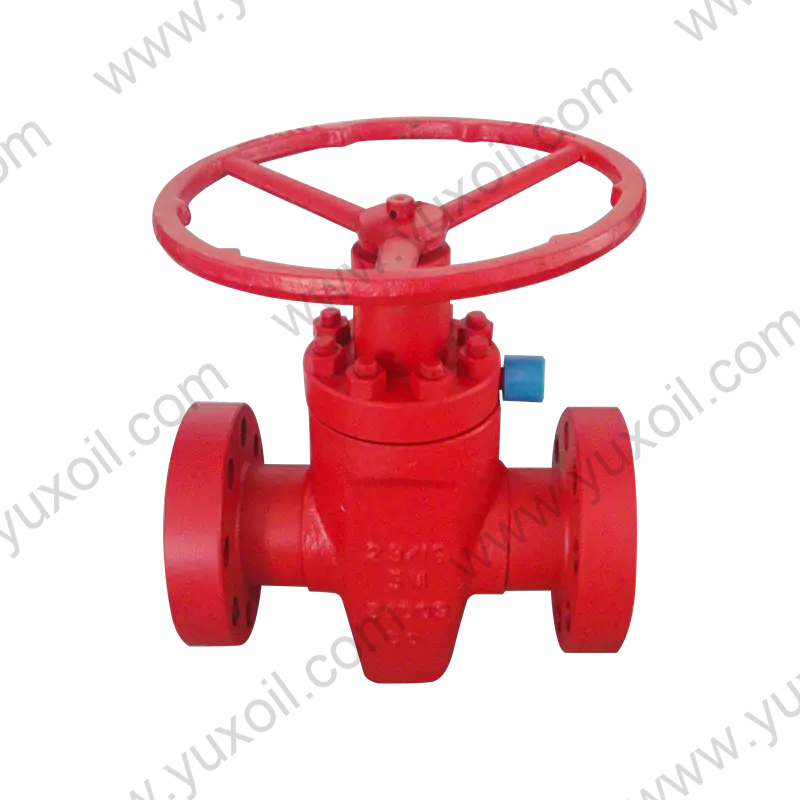 PFF Slab Manual Gate Valve with Bidirectional SealingThe PFF series offers a parallel gate design in sizes 2-1/16" to 4-1/16" and pressures up to 5000 psi, featuring bidirectional sealing and floating seats for reliable shut-off in production and manifold applications.View Product →
YUXOIL offers the PFF slab manual gate valve in the standard API 6A configuration. The body is pressure-tested before shipping, and the port connection is available in flanged or clamped versions to match the existing wellhead stack.
The FC and FLS gate valves are two compact API 6A configurations used in wellhead and manifold equipment. The FC design offers a simple flow path and is often selected for installations where space is limited. The FLS design provides a different sealing geometry that operators can choose based on the expected flow pattern and pressure differential. Selecting between FC and FLS usually depends on the position of the valve in the stack and the size of the line.
Plug valves are quarter-turn valves. A cylindrical or tapered plug with a port rotates 90 degrees to open or close the flow path. Because the operation is fast, plug valves are often used in fracturing lines, discharge manifolds, and distribution systems where an operator needs to isolate a line quickly. A plug valve offers a full-bore or reduced-bore opening. The tightness of the seal depends on the fit between the plug and the body and, in some designs, on a sealant injected into the valve.
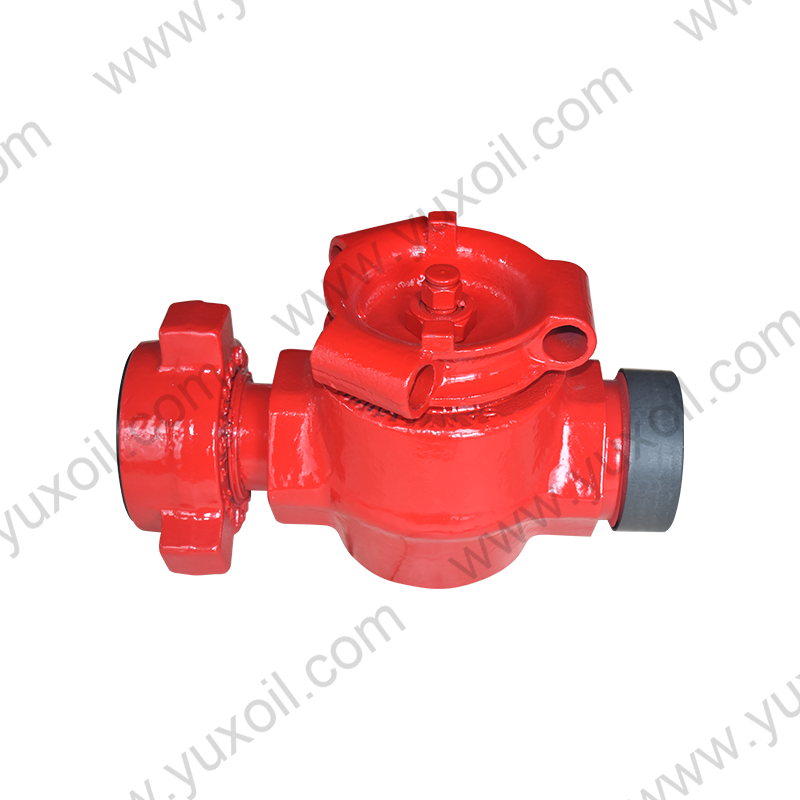 FMC Plug Valve for High-Pressure Fracturing LinesThis plug valve provides quarter-turn operation with low torque, designed for high-pressure liquid control in well consolidation and fracturing, featuring a 1502 outlet and metal-to-metal sealing for reliable performance.View Product →
YUXOIL supplies plug valves built for high-pressure oilfield service. The design is compatible with common manifold and wellhead connection patterns, which allows direct replacement in many fracturing and production setups. When selecting a plug valve, look at the operating torque. If the valve is hard to turn, the operator may need to apply excessive force, which can damage the stem or the packing. A properly fitted plug valve with the right sealant or trim material will turn smoothly and hold pressure without leaking.
One of the most common decisions in surface well equipment is whether a gate valve or a plug valve is the right choice for a specific line. The answer depends on the frequency of operation, the allowable pressure drop, and the space available.
| Feature | Gate Valve | Plug Valve |
|---|---|---|
| Operation | Linear / rising stem | Quarter turn (90 degrees) |
| Flow when open | Full bore, minimal pressure drop | Full or reduced bore |
| Operating speed | Slower, can be actuated | Fast, easy manual operation |
| Shutoff reliability | Excellent, especially expanding gate | Excellent with proper fit and sealant |
| Typical position | Christmas tree, wellhead, manifold isolation | Fracturing lines, distribution manifolds |
| Maintenance risk | Seat and gate erosion in dirty service | Stem torque increase, sealant maintenance |
Specifying a valve for oil and gas surface equipment means answering six questions before placing an order:
Each answer changes the valve design. For example, a well producing with 12 percent H2S and a surface temperature above 250 degrees Fahrenheit requires a specific material class and temperature rating. Ignoring these requirements is a procurement risk that directly affects well lifecycle cost.
Once the valve specification is set, the supplier's capability becomes the main risk factor. A reliable valve supplier must control the full chain: casting, machining, assembly, and testing. Companies that outsource everything may not be able to guarantee consistent material properties and wall thickness.
YUXOIL operates a valve factory and a casting factory in the same facility, which covers the main production steps. The company has a 13,000-square-meter plant with more than 30 large, medium, and precision machining units. It also performs chemical and mechanical testing, non-destructive testing, metrology, and product type tests. That level of in-house control helps keep valve bodies, gate surfaces, and sealing areas within the tolerances that API 6A requires.
A practical way to evaluate a supplier is to ask for a detailed description of the manufacturing process: where the casting comes from, how heat treatment is contracted, what testing is done on each valve body, and how the pressure test is recorded. The answers reveal whether the supplier is a real manufacturer or a trading company.
The cost of a valve is a small fraction of the cost of a well intervention in the oil and gas industry. A valve that fails during a fracturing job or a tree changeout can cost tens of thousands of dollars in downtime and lost production. That is why the valve specification must be made carefully at the start, not negotiated after a failure.
Start with the duty cycle. Choose a gate valve when you need full-bore flow and long-term shutoff. Choose a plug valve when you need fast quarter-turn operation on a manifold or fracturing line. Verify the API 6A class, material class, and PSL level against the actual well data. Then confirm that the supplier has the casting, machining, and testing capability to build the valve consistently. With those steps, the valve on your Christmas tree, casing head, or discharge manifold will perform as designed for years.
 No. 161, Yanhe Middle Road, Yanhe Town, Jianhu County, Yancheng City, Jiangsu Province, China
 +86-13961903990
 +86-515-86598285
 +86-515-86590688
Copyright © Jianhu Yuxiang Machinery Manufacturing Co., Ltd. All Rights Reserved.
 Login Wholesale High Pressure Wellhead/Drilling Equipment Manufacturer

 English
 русский
 Español