-

+86-13961903990

+86-13961903990
Industry News
 Home / News / Industry News / Types of Gas Valves: A Practical Guide to Selection and Service in Oil and Gas
 2026.10.26
 Industry News
Content
Ask a room of engineers to list the types of gas valves and you will get a slightly different list from every one of them. That is not confusion; it is because "gas valve" describes a duty rather than a single product. In natural gas gathering, wellhead service, compressor stations and plant piping, the right answer depends on whether you need tight isolation, controlled flow, one-way protection or a safe release of overpressure.
We manufacture valves and wellhead equipment for oil and gas service, so this overview comes from the shop floor as much as from the catalogue. Below are the main types of gas valves you are likely to work with, what each one does well, and the details that usually settle the selection.
Two simple systems cover almost every valve you will meet on a gas line.
Gas service adds rules of its own. Gas is compressible and will find its way through gaps that would never pass liquid. It is usually dry, so the medium itself provides no lubrication. And in upstream and midstream work it often arrives hot and at high pressure. Those three facts explain why gas valves so often use metal-to-metal seating, packing designed for emission control, and body ratings comfortably above the working line pressure.
When a valve will spend its life either fully open or fully closed, and you want a clear, full-bore path, a gate valve is usually the first choice. The gate slides across the flow, so pressure drop is almost nil and wireline or pigging work is not obstructed.
Slab gate valves, including the PFF style, use a single solid plate closing against two seats. Expanding gate valves split the gate into two halves that spread apart as the valve closes, pressing hard against both seats and producing a very tight seal under high pressure. FC and FLS designs are also common in the field. If you would like the standards background, there is a useful explanation of the role of API 6A gate valves in oil and gas on our site.
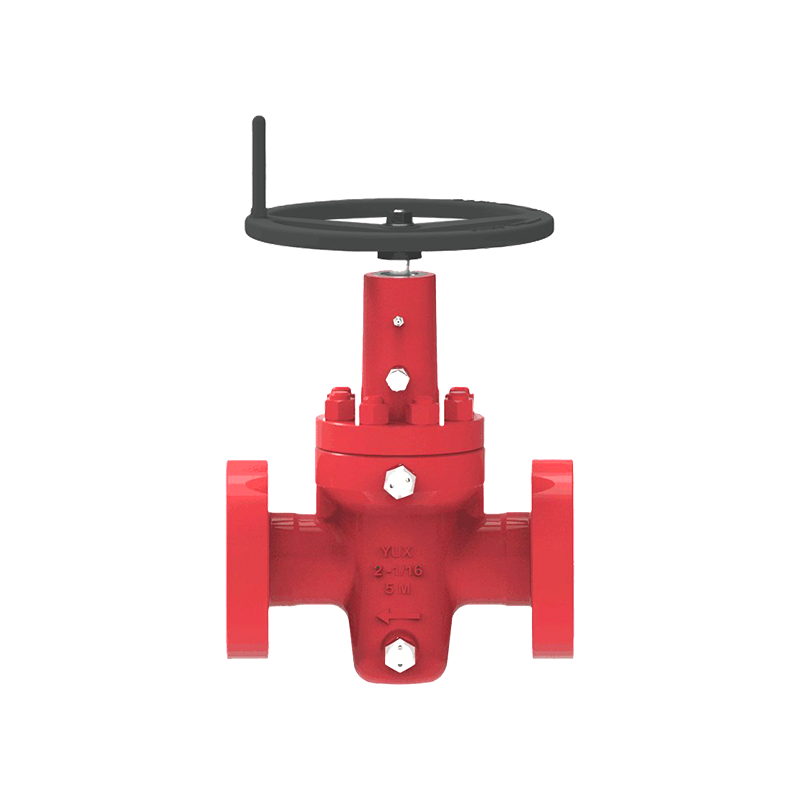 WKM Expanding Gate Valve API 6A for Oil and GasWorth viewing for reliable isolation in high-pressure oil and gas applications, featuring low operating torque and metal seals.View Product →
The one thing a gate valve should never be asked to do is throttle. Holding a gate partially open sends high-velocity gas across the seat faces and erodes them quickly. Use it for isolation and it will serve for years.
A plug valve uses a cylindrical or tapered plug with a through port. Turn it ninety degrees and the port either lines up with the flow or faces the body wall. The motion is quick, the design is mechanically simple, and it tolerates dirty or sandy gas streams better than most soft-seated valves, which is why plug valves appear in gathering lines, compressor stations, wellhead manifolds and fracturing spreads.
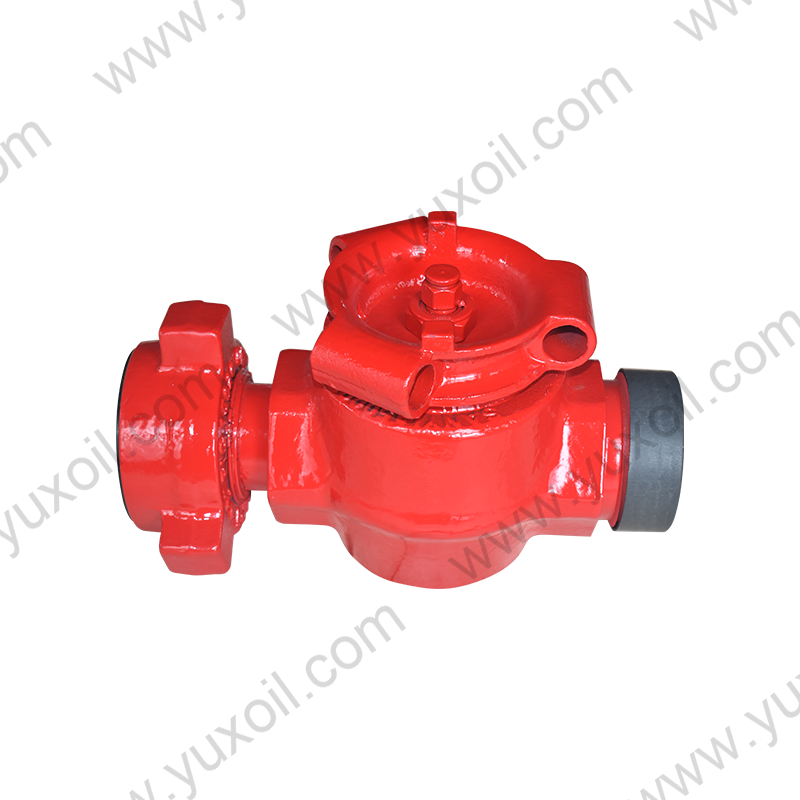 FMC Plug Valve for Well Consolidation and Fracturing OperationsWorth viewing for dirty gas streams and fracturing, with fast opening and small torque, but note higher operating torque than ball valves.View Product →
Lubricated versions inject sealant to keep the plug free and sealing, while non-lubricated versions rely on a lining or on careful taper geometry. Expect operating torque to be higher than on a ball valve, and specify the actuator with that in mind.
The ball valve is the rotary cousin most people picture first. A drilled sphere rotates against two seats, giving tight shutoff, low torque and a compact body. Floating-ball designs suit smaller sizes, while trunnion-mounted balls carry the load in larger, higher-pressure gas lines.
Soft seats seal extremely well on clean, dry gas but have temperature limits. Where fire safety matters, look for fire-safe tested designs and anti-static construction. Ball valves also automate easily, which makes them a popular choice for remotely operated gas lines.
If the job is to control flow rather than simply stop it, a globe valve is the honest answer. The plug moves perpendicular to the seat, forcing gas through a shaped path, so the valve can be set at intermediate positions without destroying itself.
The cost is a real pressure drop, which is why globe valves are rarely used as isolation devices on long gas runs. Needle valves are the small-bore version of the same idea, and they are everywhere in instrument gas, sampling and gauge lines.
Not every gas valve waits for an operator. A check valve opens with forward flow and closes the moment flow reverses, protecting compressors, pumps and meters from backflow. Swing, lift, dual-plate and piston designs are all used in gas service; the selection usually comes down to how quickly the disc must close and how much pressure drop is acceptable.
Relief and safety valves are the last line of defence. Spring-loaded and pilot-operated types release gas when pressure exceeds a set point, and on gas systems they deserve more attention than they often receive, because trapped or thermally expanded gas can raise pressure quickly.
Butterfly valves are compact, light and inexpensive in large sizes, so they are common on utility gas, vent and low-pressure plant lines. They are not wellhead valves; the disc sits in the flow path and the seat is easily damaged by throttling at high velocity.
Diaphragm valves isolate the mechanism from the medium with a flexible diaphragm, which suits corrosive, wet or particle-laden gas at moderate pressures and temperatures.
| Valve Type | Motion | Typical Gas Duty | Main Watch-Out |
|---|---|---|---|
| Gate (slab, PFF) | Linear | Full-bore isolation | Never throttle with it |
| Expanding gate | Linear | High-pressure gas isolation | More parts, correct travel needed |
| Plug | Rotary, quarter turn | Fast isolation in dirty gas | Higher operating torque |
| Ball | Rotary, quarter turn | General isolation, easy automation | Soft-seat temperature limits |
| Globe / needle | Linear | Regulation, instrument gas | Noticeable pressure drop |
| Check | Self-acting | Backflow prevention | Sizing and cracking pressure |
| Relief / safety | Self-acting | Overpressure protection | Set pressure and certification |
| Butterfly | Rotary, quarter turn | Large low-pressure gas lines | Seat wear, throttling noise |
In our own shop, four questions come before any recommendation.
Answer those and the list of suitable designs narrows quickly. From there, material selection, end connections and testing requirements finish the picture. If you would like to see how a valve moves from casting to final pressure test, our manufacturing process page shows the steps we control in house.
The types of gas valves are not really a list to memorise; they are a set of tools, each matched to a duty. Keep isolation, regulation, backflow protection and overpressure protection separate in your thinking, and the right valve usually becomes obvious.
If you are working through a specification for a wellhead, manifold or fracturing line and would like a second opinion, talk to us. We are glad to look at the application with you and suggest what fits, including the options you may not actually need.
 No. 161, Yanhe Middle Road, Yanhe Town, Jianhu County, Yancheng City, Jiangsu Province, China
 +86-13961903990
 +86-515-86598285
 +86-515-86590688
Copyright © Jianhu Yuxiang Machinery Manufacturing Co., Ltd. All Rights Reserved.
 Login Wholesale High Pressure Wellhead/Drilling Equipment Manufacturer

 English
 русский
 Español