-

+86-13961903990

+86-13961903990
Industry News
 Home / News / Industry News / How Do You Select the Right 6A High Pressure Gate Valve Body for Your Wellhead Application?
  2026.06.29
 Industry News
Content
Selecting the right 6A high pressure gate valve body comes down to matching five core parameters — working pressure, bore size, material class, product specification level (PSL), and end connection — to your specific well conditions. Get any one wrong, and the valve body you install may comply with the API 6A label on the nameplate yet fail catastrophically under actual service conditions. This guide walks through each selection criterion in the order that engineering teams and procurement specialists should address them.
The valve body's rated working pressure must equal or exceed the maximum anticipated shut-in wellhead pressure (SIWHP) — not the normal operating pressure. Operators frequently underspecify here by selecting a valve body rated to the expected flowing wellhead pressure, only to expose it to full reservoir shut-in pressure during a well kill or emergency closure.
API 6A defines six standard working pressure ratings for gate valve bodies:
| Working Pressure (psi) | Hydrostatic Test Pressure (psi) | Typical Well Type |
|---|---|---|
| 3,000 | 4,500 | Low-pressure gas, water injection |
| 5,000 | 7,500 | Conventional oil and gas wells |
| 10,000 | 15,000 | High-pressure gas, offshore platforms |
| 15,000 | 22,500 | HPHT wells, deepwater Christmas trees |
| 20,000 | 30,000 | Ultra-HPHT exploration and appraisal wells |
A practical rule: select the valve body rated to the next standard pressure class above your calculated SIWHP. If your SIWHP is 8,500 psi, specify a 10,000 psi body — not a 5,000 psi body with a "20% safety factor" applied in a spreadsheet calculation.
The gate valve body bore must accommodate two distinct requirements: production flow rates and downhole tool passage. For master valves and wing valves on a Christmas tree, the bore must allow wireline tools, coiled tubing, or workover equipment to pass without restriction.
API 6A specifies standard nominal bore sizes from 1 13/16 inch through 7 1/16 inch, but not every bore is available at every pressure rating. The higher the working pressure, the thicker the body wall required, which limits maximum bore at any given outer envelope size. Key selection guidance:
The API 6A material class governs the base material requirements for the valve body and all pressure-retaining components. It is the parameter most frequently underspecified or incorrectly specified in purchase orders — and the one with the most severe consequences when wrong. A valve body manufactured to Material Class AA and installed in a sour gas service well can suffer sulfide stress cracking (SSC) within weeks of first production.
| Material Class | Service Environment | Body Material | Hardness Limit |
|---|---|---|---|
| AA | General (sweet) service | Carbon steel (AISI 4130) | No restriction |
| BB | General service, low-temp | Carbon steel, Charpy impact tested | No restriction |
| CC | Mild sour service | Low-alloy steel, NACE partial compliance | ≤26 HRC |
| DD | Sour service (H₂S) | AISI 4130/4140, NACE MR0175 compliant | ≤22 HRC |
| EE | Sour service, higher alloy | Low-alloy steel or stainless, NACE compliant | ≤22 HRC |
| FF | Severe sour / CO₂ service | Stainless steel or CRA body | ≤22 HRC |
| HH | Full sour / CRA service | Full CRA (Inconel 625, Alloy 718, duplex SS) | Per NACE MR0175 |
The threshold for mandatory sour service material class is H₂S partial pressure ≥ 0.05 psia as defined in NACE MR0175. At a wellhead operating pressure of 5,000 psi with just 10 ppm H₂S in the gas stream, the H₂S partial pressure already exceeds this threshold — requiring at minimum a Material Class DD gate valve body.
The physical configuration of the gate valve body determines how it integrates into the wellhead stack and Christmas tree. Two decisions drive body configuration selection:
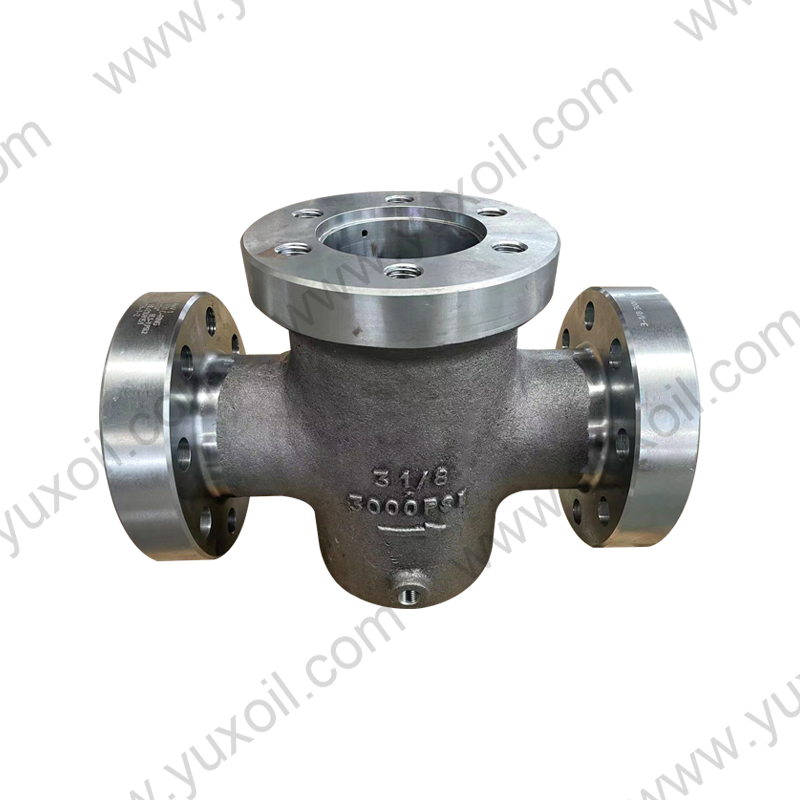
A tee body has a single through-bore axis with the bonnet on a perpendicular branch — the standard configuration for master valves, wing valves, and swab valves on a Christmas tree. A cross body adds a fourth port opposite the bonnet, enabling dual-side access used in certain manifold and testing configurations. Cross bodies are significantly heavier and more expensive; specify them only where the fourth port serves a functional purpose.
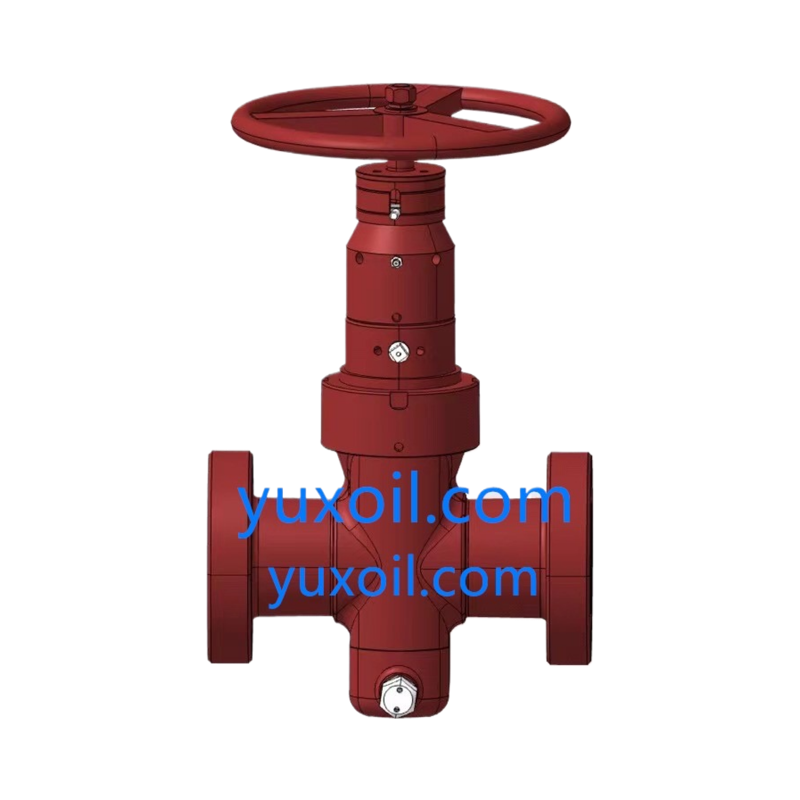
The bonnet seals the top of the valve body around the stem. Bolted bonnets allow field replacement of the stem seal packing stack without removing the valve from the wellhead — a critical maintenance advantage on producing wells where taking the well off-stream is costly. Pressure-seal (integral) bonnets use wellbore pressure to energize the seal and are preferred for 15,000 psi and 20,000 psi bodies where bolted flange integrity under cyclic loading is a concern. Most operators specify bolted bonnets up to 10,000 psi and pressure-seal designs above that threshold.
PSL defines the minimum manufacturing quality, inspection, and testing requirements for the gate valve body. A higher PSL does not change the pressure rating or material class — it changes how thoroughly the body is verified before shipment. For high-pressure wellhead gate valve bodies, the correct PSL is determined by the consequence of failure, not the available budget.
The gate valve body end connections must match the mating wellhead equipment exactly. API 6A defines two flange types for high-pressure gate valve bodies, and mixing them creates an unsafe non-compliant interface:
When specifying the end connection, the purchase order must state: nominal bore, working pressure, API 6B or 6BX designation, ring groove number (e.g., R-46, BX-151), and whether a raised-face or RTJ face finish is required. All six parameters are needed for an unambiguous connection specification.
API 6A defines seven temperature classes for gate valve bodies. The temperature class governs not just the body material ductility at low temperatures but also the seal materials, elastomer grades, and grease specifications used inside the valve body. A valve body rated to Temperature Class P (−20 °F to 250 °F) will have body seals and packing that are not rated for arctic service — even if the steel body itself would survive the cold.
For true HPHT applications — defined by API as wellhead pressures above 15,000 psi and temperatures above 300 °F — standard elastomeric seals in the gate valve body are inadequate. HPHT gate valve bodies require fully metallic stem seals, spring-energized PTFE lip seals, or graphite packing rated to 450 °F+, plus body wall thickness validated by FEA analysis rather than standard API 6A formula-based calculations.
Based on recurring failures in the field and non-conformances identified during third-party inspection, the following errors account for the majority of improperly specified 6A high pressure gate valve bodies:
Use the following checklist when preparing a valve body specification or evaluating a manufacturer's data sheet:
Selecting the right 6A high pressure gate valve body is a multi-parameter engineering decision, not a catalog lookup. The working pressure rating, material class, PSL, and end connection must each be independently derived from well data — not assumed from previous project experience or defaulted to the lowest available specification. A valve body that is incorrectly specified in any single parameter represents a pressure containment risk at the wellhead, a regulatory compliance failure, and a potential well control incident.
The investment in a properly specified PSL 3, PR2, Material Class DD or HH gate valve body at the front end of a project is consistently less expensive than the cost of a wellhead valve replacement on a producing well — or the consequences of a wellbore integrity failure in service.
 No. 161, Yanhe Middle Road, Yanhe Town, Jianhu County, Yancheng City, Jiangsu Province, China
 +86-13961903990
 +86-515-86598285
 +86-515-86590688
Copyright © Jianhu Yuxiang Machinery Manufacturing Co., Ltd. All Rights Reserved.
 Login Wholesale High Pressure Wellhead/Drilling Equipment Manufacturer

 English
 русский
 Español